


1 in 20,000: what it's like at EGU

When 20,000 climate scientists converge on a conference, train travel becomes a little tricky. Rishul Karia discovered it firsthand when he tried to book the Eurostar for his first academic conference; “all the climate scientists had sold out the reservation tickets!” In the end, he arrived in Vienna after sixteen hours on various trains, ready for one of the largest geoscience gatherings in the world.
EGU - the European Geosciences Union’s annual gathering - brings together earth and planetary scientists for a week of talks and events. Rishul, a first-year PhD student with the Centre for Climate Repair, went to present his research on direct air capture (DAC).
“As luck would have it, my poster presentation was on the afternoon of the first day,” he said. It meant a quick dive into the event; a poster presentation at EGU is not a passive affair, but involves up to four hours of discussion with fellow researchers who pop by the stand.

Rishul is president of his college, Clare Hall - and is proud to represent them when he can!
Rishul’s research is a collaboration between Cambridge’s Department of Engineering and Yusuf Hamied Department of Chemistry. It focuses on furthering understanding of a novel type of DAC being developed by the Forse group. If it works, it could be a useful way to scale up carbon dioxide removal and tackle the excess of greenhouse gases in the atmosphere. Over the past few months since starting his PhD, he has been writing a model to ascertain the underlying physics behind the process, known as supercapacitive swing adsorption.
“People were very intrigued by the specific type of DAC we are looking at,” he said. Beyond sharing his findings, Rishul said he gained “valuable insight” from other academics and had conversations that will help shape his research going forward. He also got to see a few friendly faces: CCR Deputy Director Jerome Neufeld, a couple of members of the inaugural QCES cohort, and a surprise appearance from a Clare Hall alumna.
After the poster session, he got to enjoy the packed programme. ARIA held a session on “Advances in Understanding SRM Technologies and their Impact on the Earth System” which he said was “absolutely fascinating… I learnt about the potentials and drawbacks of SAI and other novel SRM technologies.” This fed nicely on to a discussion on the “Overarching Great Debate on Geoengineering” which, he said, gave “further context for the work we do at CCR and why it is so important.”
The best advice I had pre-conference was to not go to everything - as tempting as it can be.
“I realised how intense being an academic can be; full days of back-to-back talks, discussions, and networking.” The best piece of pre-conference advice he received, he notes, was to resist the urge to attend everything. For Rishul, this included a quick detour to the nearby mountains on a quiet afternoon to reset before two more busy days.
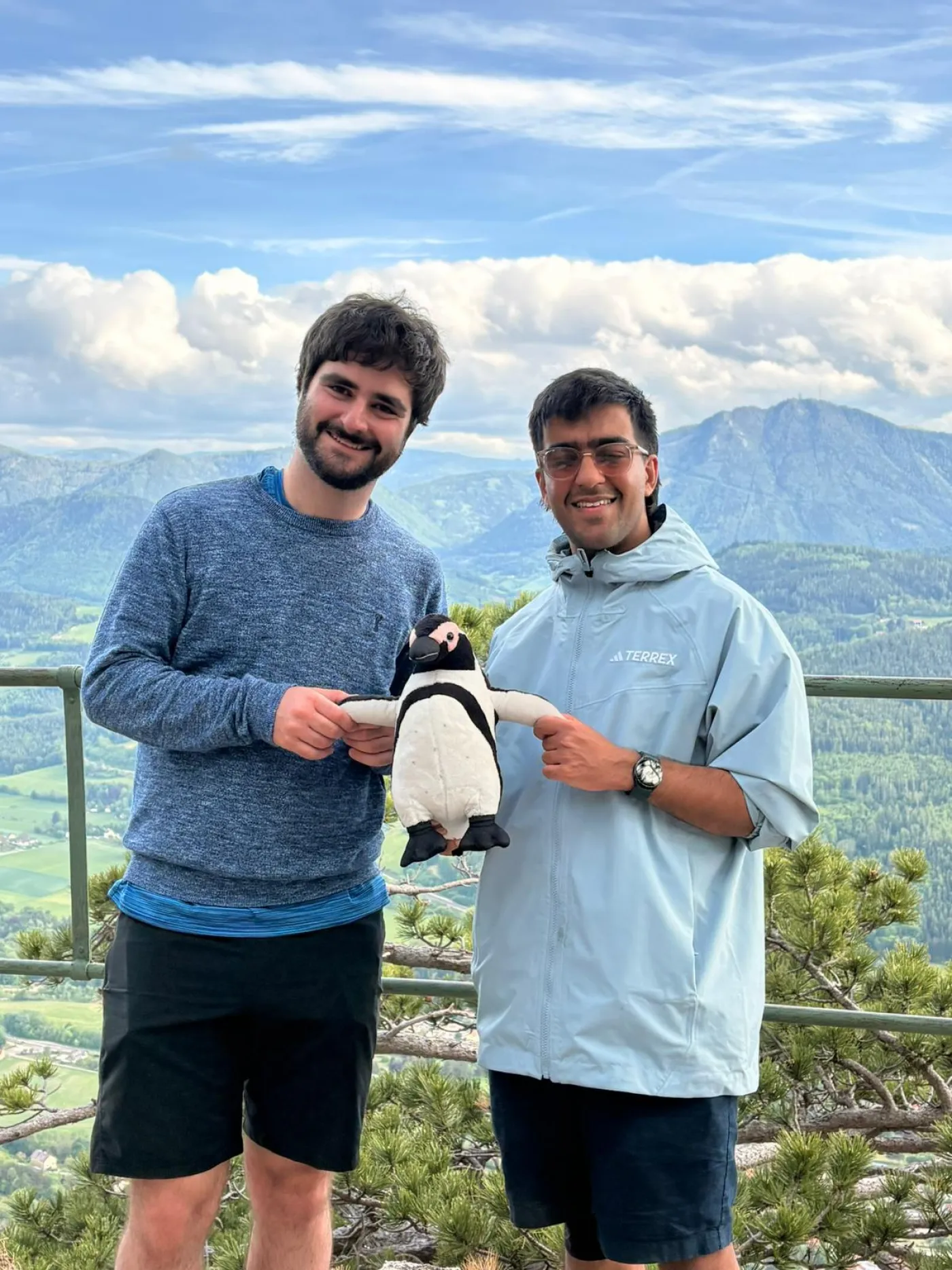
Two sides of conference life: from networking in the mountains...
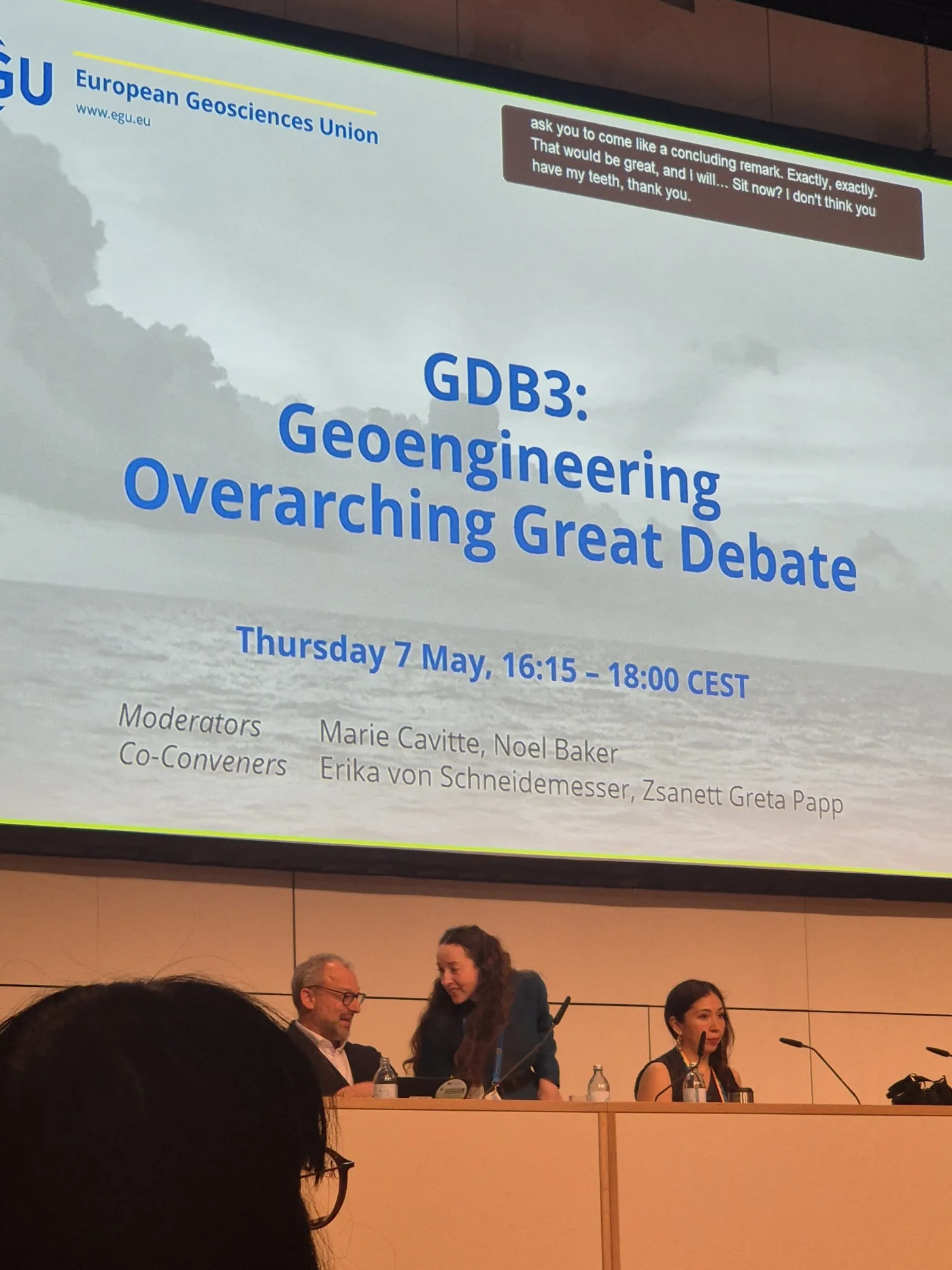
...to a cutting-edge debate.
It was the community aspect that stood out the most. Free public transport for badge-holders meant he spotted attendees unexpectedly across the city. He found himself adopted by a group of oceanographers for the duration of the conference, and attended dinners with a variety of people. On one occasion, he bumped into an interesting speaker at the station and ended up inviting him along for dinner, too. But the highlight of EGU, he said, was the free drinks and pretzels available every day at 6pm. He “could only have the lemonade, but appreciated the sentiment.”
Rishul’s journey was supported by Clare Hall’s Boak Fund, which helps students get to events like these.
Now back in Cambridge (just in time to present again at CCR’s Symposium), he has plenty of ideas for what comes next. “It was a thoroughly enjoyable experience, despite the early challenges and I learnt a lot. Now it's time to implement that in my own research and look toward potential collaborations with those I met.”

The next day, Rishul spoke at the Climate Repair Symposium in Cambridge. You can find out more about the Centre for Climate Repair's research on their website. Photo by Paul Ashley.