


Reduce, remove,
and refreeze
On our current trajectory, emissions reductions alone will not keep global warming below 1.5°C. Net zero remains the non-negotiable foundation - enshrined in law and indispensable - but the scale and pace of change now demand a fuller strategy.
At CCR, that strategy is the “Three Rs”: Reduce emissions, Remove greenhouse gases and Refreeze the Arctic. Each is essential; none is sufficient on its own.
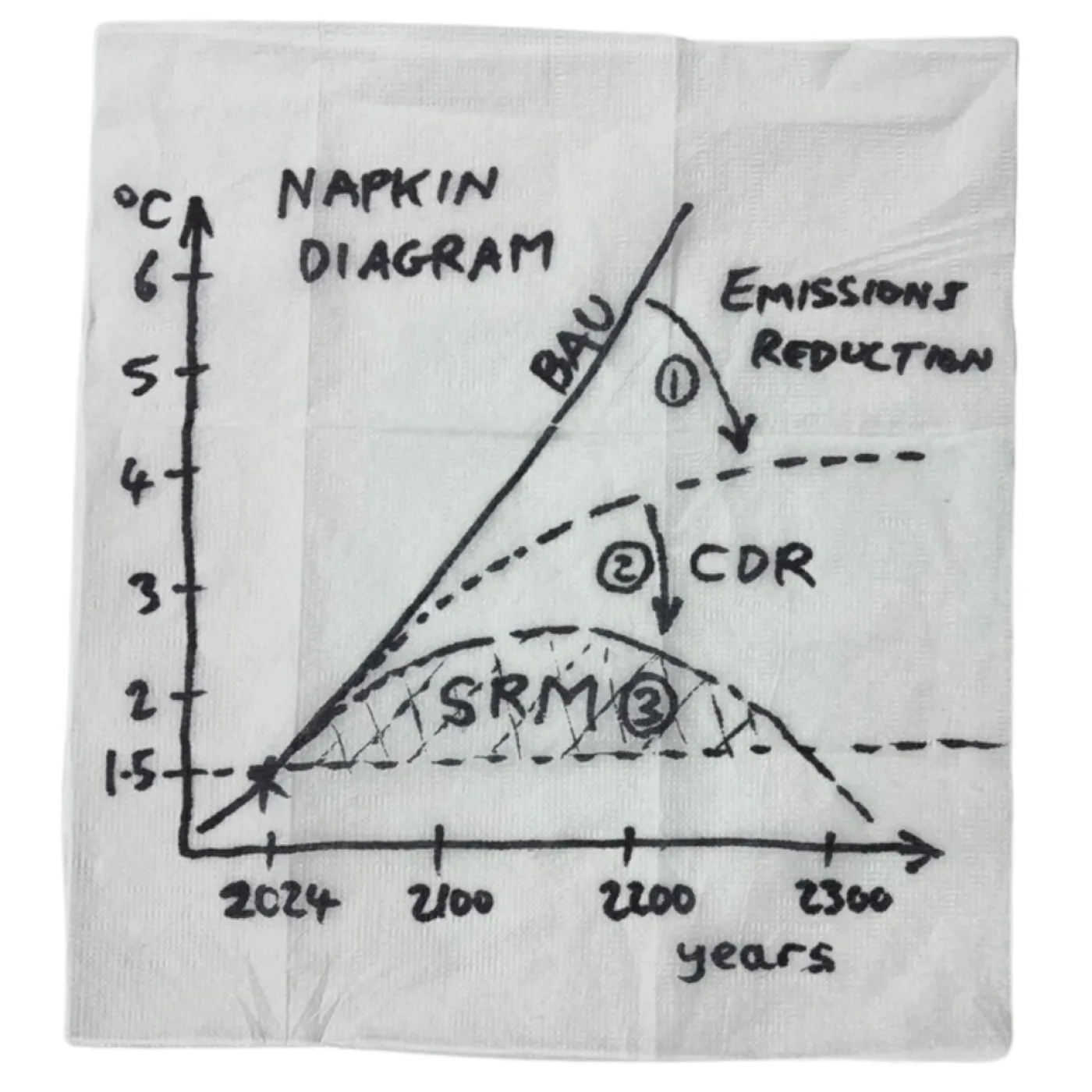
The Napkin Diagram
Originally by John Shepherd, University of Southampton, in 2010, this diagram helps visualise the three Rs:
- Reducing emissions
- Removing greenhouse gases
- Solar radiation management (SRM) - a part of what we call "Refreeze"
All three are necessary to avoid catastrophic; emissions reduction alone is not enough.
Reduce emissions rapidly

Emissions reduction is central to climate mitigation and must include innovations in every sector of society to achieve net-zero emissions. There is an urgent need for society to get off fossil fuels and limit deforestation.
Remove greenhouse gases

In addition to reducing emissions, there is a need to remove greenhouse gases from the atmosphere, especially carbon dioxide and methane. Our research covers a spectrum of approaches from ecosystem restoration to engineered solutions.
Refreeze the Arctic

The third R - refreezing the Arctic - has moved from speculative concept to structured inquiry. Our current phase is firmly about understanding whether interventions, such as brightening marine clouds or rethickening sea ice, make sense physically and ecologically.
The action we need
- Time is running out: the level of atmospheric CO2 is now too high for safety.
- CO2 takes hundreds of years to clear from the atmosphere, so it’s no longer enough just to stop emitting it, and action can’t wait until we reach zero emissions (which many nations have committed to do by 2050 or 2060).
- We must urgently research ways to take CO2 out of the atmosphere safely.
- We must also urgently research ways to repair damaged parts of the climate system – e.g., how do we refreeze the poles?
From research to governance
What happens if the evidence shows an intervention is feasible, scalable and effective and parts of the world face acute, lethal heat or other climate emergencies? The question then moves from laboratories to legislatures and international institutions. Decisions about deployment should not be taken unilaterally; they demand anticipatory governance - multinational, transparent, and accountable - well before any crisis compels action. Our role as researchers is to generate reliable knowledge and options; society’s role is to determine, through inclusive governance, whether and how to use them. That conversation must begin now, not at the height of an emergency.
A ten-year roadmap
We are operating on a decisive timescale. The vision for the next decade is to determine which approaches across the Three Rs are truly scalable and to develop credible roadmaps for rapid expansion if society chooses to proceed. Not all lines of inquiry will prove to be appropriate - indeed, some will rightly be set aside. But by the end of this 10-year programme, we aim to have established what works, what doesn’t and what is ready to scale responsibly.
The Centre for Climate Repair’s mission is not to promise silver bullets; it is to further knowledge and deliver clarity. Emissions reduction remains the immovable first pillar. Carbon removal is a necessary complement. Refreezing, the term we have adopted to include a range of climate interventions, may buy time to protect critical cryospheric systems while decarbonisation accelerates. Together, these strands form a pragmatic response to an extraordinary challenge - grounded in science, guided by communities and oriented toward governance that matches the stakes.