


Fluid mechanics for the climate

At the University of Cambridge, we're investigating how aerosol particles could cool the planet. It's an exciting mix of chemical engineering, mechanics, and physics in a rapidly growing field, and it could have world-changing applications. Could you join our team?
When Mount Pinatubo erupted in 1991, it released around 20 million tonnes of sulphur dioxide to an altitude of over 20 kilometres. Over the next year, this release of materials resulted in cooling of near 1°C.
In a world struggling to reduce greenhouse gas emissions quickly enough to prevent dangerous warming, the question is being asked: what if we could replicate that cooling effect in a controlled manner to buy us more time?
Stratospheric Aerosol Injection - which takes its inspiration from volcanic eruptions - is being studied around the world. It has been shown to have great potential for cooling the planet, but there are still many unknowns.
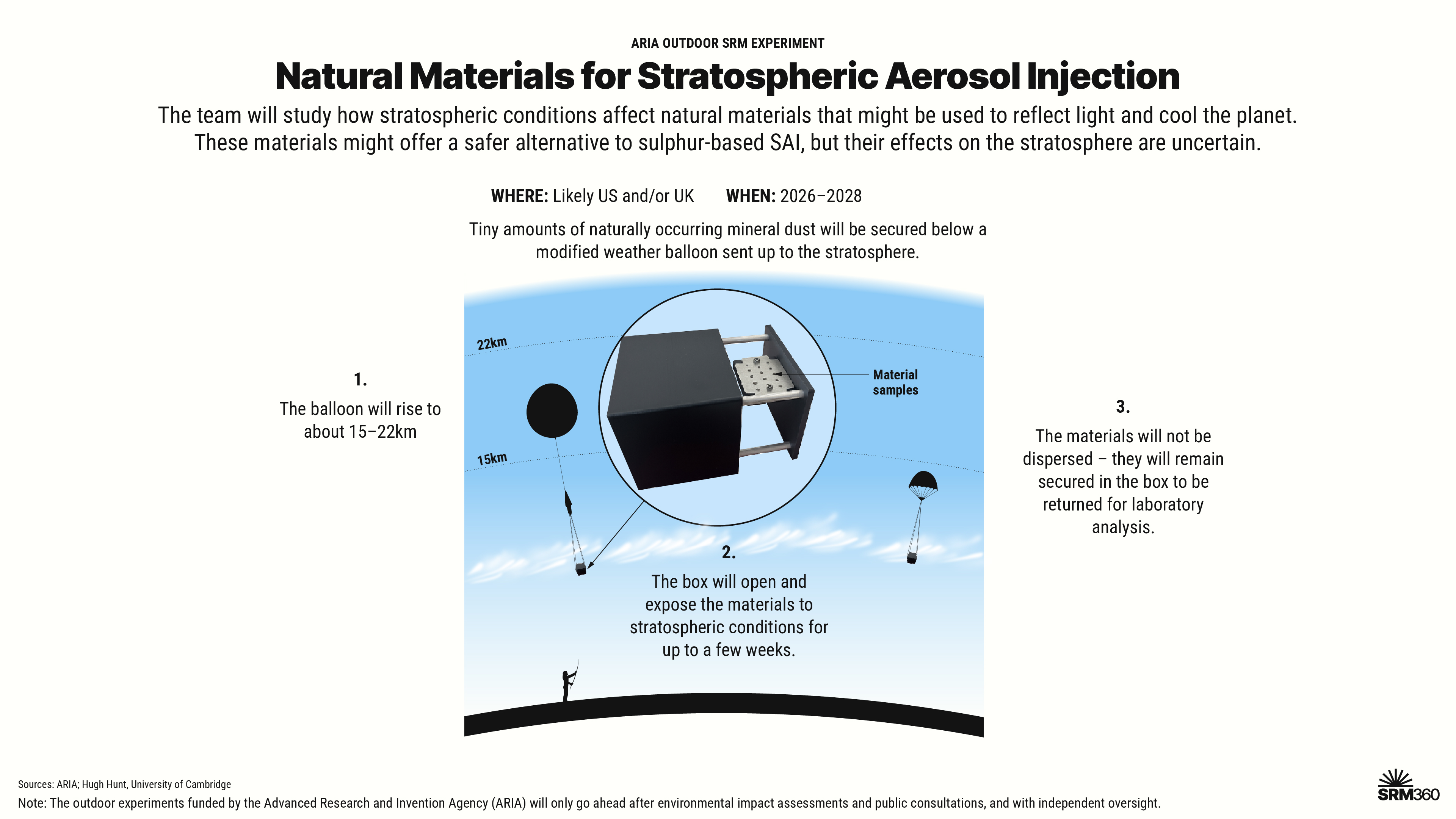
Here in Cambridge, we're leading a project to investigate whether materials other than sulphur dioxide could be a feasible alternative with fewer hazards. These could include silicon dioxide, calcium carbonate, titanium dioxide, and various others.
We want to investigate the impacts of stratospheric conditions on these materials – how they age and change. But we also want to investigate how they might be delivered and dispersed effectively - this is where fluid mechanics, and in particular the wonderful problem of two-phase flow, comes in!
Funded by the Advanced Research + Invention Agency (ARIA), we are collaborating with members of Harvard University and Imperial College London to design experiments to try and answer these questions. These won't involve releasing any material into the atmosphere, but should tell us the effects of the stratosphere on the materials. (Any outdoor experiments will only go ahead after environmental impact assessments and public consultations, and with independent oversight.)
Could you be a part of it?
Get involved
We're advertising for two post-doctoral research positions to consider dispersal and delivery.
On dispersal, you'll think about the factors affecting the design of a nozzle and devise indoor laboratory experiments to test it.
On delivery, you'll explore possible systems to produce a steady flow of materials. This will be a design project, but if you have ideas for indoor experiments to test some aspects of the design then we can do that too.
If these sound like something you're interested in, get in touch or apply here: Vacancies | Centre for Climate Repair

Stratospheric aerosol injection and marine cloud brightening are some of the most studied methods to reflect sunlight. Credit: Carmelius Cohen “the Fictional Scientist”.
More resources:
Podcast: What Is Stratospheric Aerosol Injection (SAI)? | SRM360
Overview: Stratospheric Aerosol Injection | SRM360