


So you think there's hope? In the news this weekend

"So you think there's hope?"
That's what someone asked us today at Cambridge Zero's Climate & Nature Research Showcase. On one of the hottest days ever recorded in the UK in June, we were presenting ideas - totally new to some attendees - that could slow or even reverse the impacts of climate change. It felt more poignant than ever.
Across the University of Cambridge, researchers are finding ways to protect biodiversity, advanced the energy transition, and reduce emissions across medicine, travel, buildings, and more. It's vital work and was a privilege to hear more about today.
The aim of our research is to add a few more options for protecting people and planet. Zhenna Azimrayat Andrews shared how the ocean - our largest resource - could sequester more carbon. Aliki Marina Tsopelakou presented a design that could remove methane and improve indoor air quality. Hugh Hunt expounded the idea of reflecting more sunlight, and Jacob Pantling shared how experiments to protect Arctic sea ice have been going. Jake Chapman introduced technology to make clouds more reflective, and Rishul Karia explored the ethics and scalability of Direct Air Capture.
There is so much to do - a talk by our colleague Albert van Wijngaarden, from the Scott Polar Research Institute, illuminated some of the communication challenges, for a start - but there is also so much more being done than people may realise.
So yes, we like to think there is hope. Because at this stage, in this extreme heat, we have got to try.
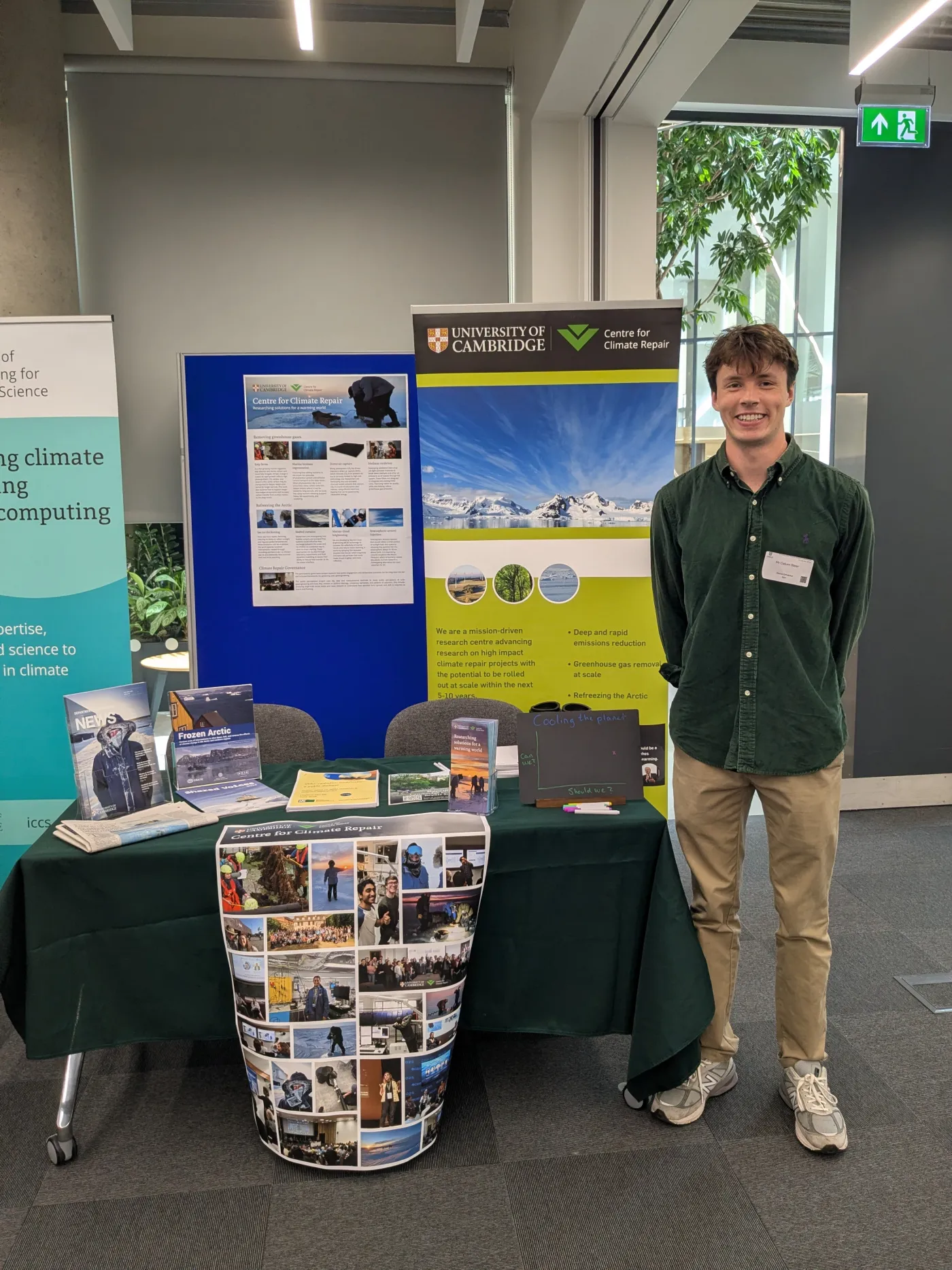
Calum Steer at the exhibition stand
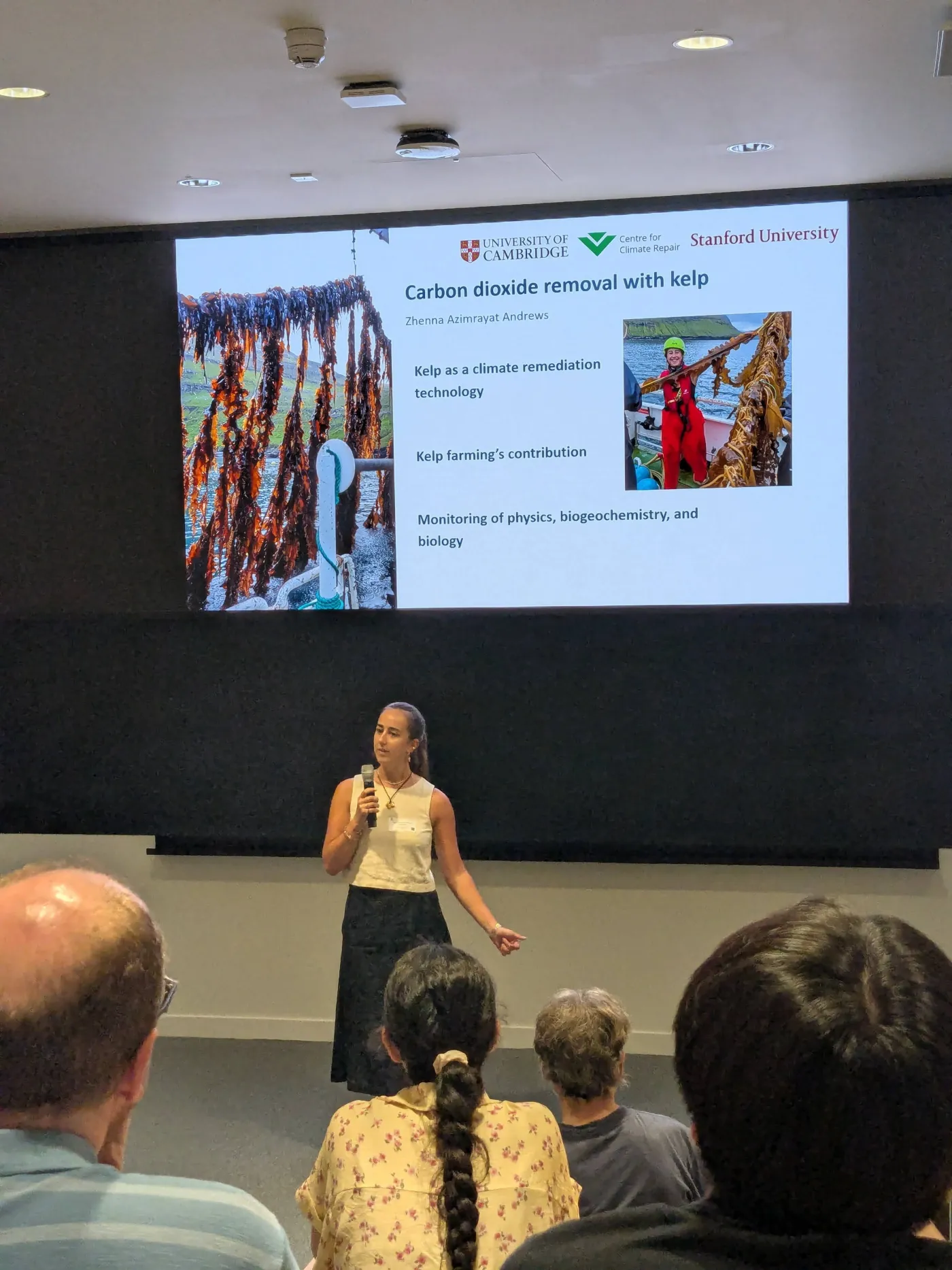
Zhenna Azimrayat Andrews presenting her research on kelp.
In the news
On the same day, Tom Whipple wrote about this changing perspective in The Times.
"...views on solar dimming have shifted from 'that’s an insane idea, we can’t do it' to 'that’s an insane idea, but maybe we should start getting the data,'" he said.
The author looks back to an historical eruption that had the effect of "dimming the sun" - something that some solar radiation management (SRM) ideas seek to replicate.
In the midst of the UK's dangerous heatwave, he questions whether these ideas really are that crazy anymore. "It would, they say, be a massive experiment in our atmosphere... Of course, the experiment we are currently doing to our atmosphere is massive too."
If you'd like to find out more, we'll be hosting weekly lunchtime seminars at the Department of Engineering at the University of Cambridge next term. Visit our website and join our mailing list for more details.