


Removing greenhouse gases

In addition to reducing emissions, there is a need to remove greenhouse gases from the atmosphere, especially carbon dioxide and methane. Our research covers a spectrum of approaches from ecosystem restoration to engineered solutions.
Here the research question is not ideological but practical: what works, at what scale, with what risks and co-benefits – and under what governance? A recurring theme in our programme is to identify not only the promising levers but also those we should not pull. This “negative learning” is as valuable as breakthroughs, preventing missteps and guiding scarce resources to interventions that genuinely help.
Our approach is to proceed stepwise: understand the science, test feasibility in controlled and field settings, evaluate impacts with affected communities and then, only if evidence warrants, consider pathways to scale governed through robust, multinational processes. Effectiveness, equity and ethics are inseparable in this domain.
Read the Expert Insight: Greenhouse Gas Removals from the Centre for Climate Engagement, to which our director contributed.
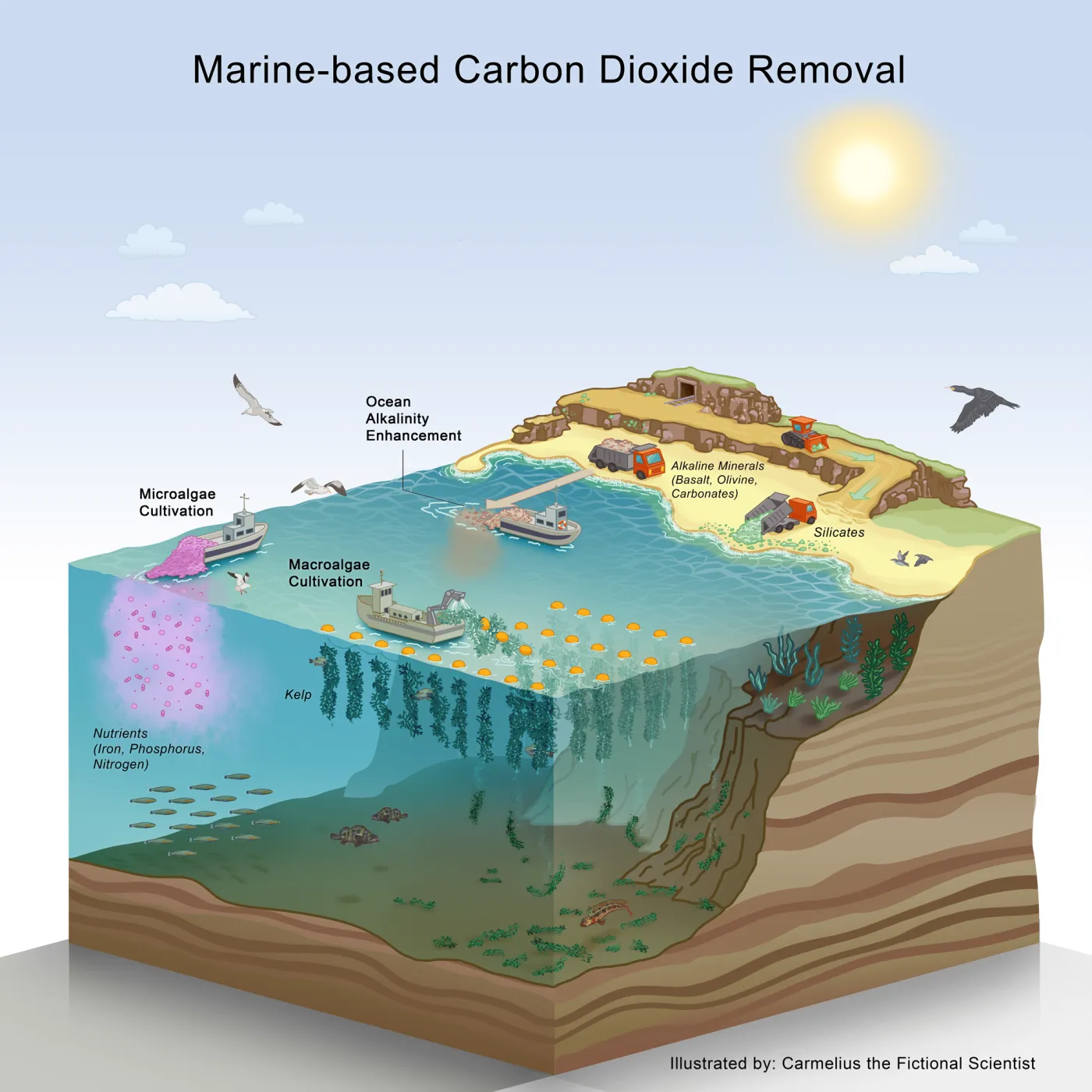
Illustration of some marine-based carbon dioxide removal approaches, as featured in Dr Dante McGrath's analysis.
Our research & collaborations
Kelp

As a fast-growing marine organism, kelp already sequesters carbon and, at scale, could potentially play a crucial role in mitigating climate change. Our researchers are studying the rate of biomass growth and carbon export to better understand kelp's potential.
Marine biomass regeneration

In the marine biomass regeneration (MBR) project, we’re exploring a novel approach to add nutrients to the ocean to stimulate phytoplankton, which naturally sinks into the deep ocean and carries carbon away from the climate system.
Direct air capture

The urgent need to reverse the rising concentration of carbon dioxide (CO2) in the atmosphere has created a strong demand for affordable and scalable carbon capture technologies. Direct air capture (DAC), which removes CO2 directly from ambient air, has gained significant attention as a key strategy for addressing emissions that have already been released. However, most current DAC technologies, based on solid amines or alkaline solutions, remain expensive and energy intensive. Researchers are developing low-cost sorbents that could help address the financial and energy costs.
Methane oxidation

Methane is a short-lived pollutant which drives climate change and harms human and ecosystem health by contributing to the formation of ground-level ozone. Despite its potency as a greenhouse gas, methane can be abated through oxidation, specifically photocatalytic oxidation. Our researchers are developing photochemical filter systems designed for integration into HVAC units, offering a dual benefit: improving indoor air quality and enabling the removal of atmospheric methane.
SEAO2-CDR

SEAO2-CDR is a collaboration funded by the EU's Horizon Europe research and innovation programme. It aims to establish and evaluate the mechanisms and processes required to ensure the environmentally safe, socially acceptable and economically viable implementation of appropriate ocean-based CDR approaches in support of global climate policies.