



Sea ice thickening
Arctic sea ice is crucial for regulating global temperatures, but it is melting at an unprecedented rate due to climate change. While reducing emissions is the only way to sustainably preserve the ice long-term, additional localised actions may help to slow the melting and the rate of ice loss. Through field trials and modelling to assess potential approaches to thicken Arctic sea ice - to potentially slow summer melt, reduce Arctic warming, and mitigate further ice loss.
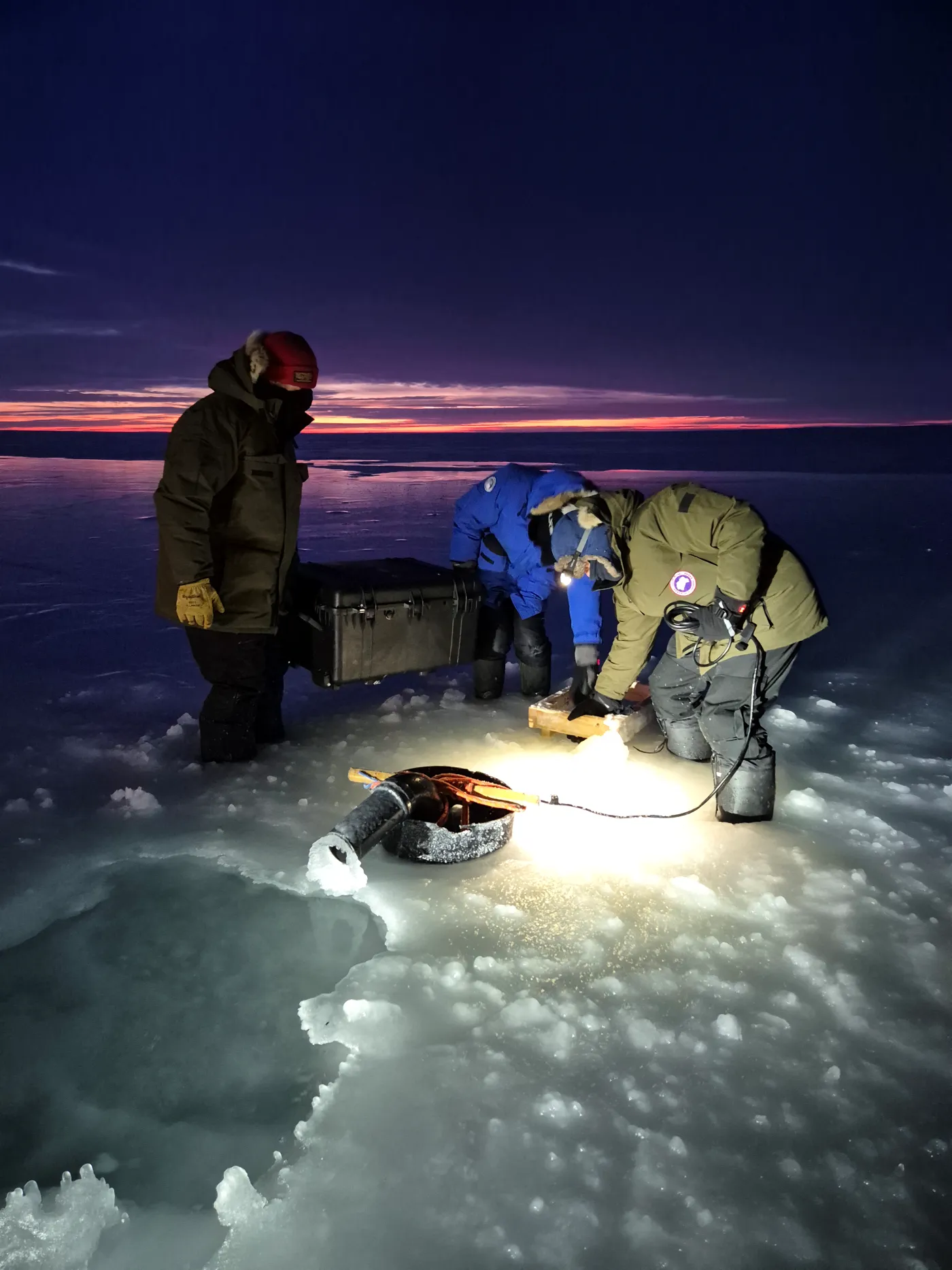
Retrieving equipment at the end of the day. Image by Real Ice.
The loss of Arctic sea ice is a global issue. The bright white ice reflects solar radiation back into space, cooling the planet. As it gets warmer, the reflective ice is replaced by dark ocean water that absorbs the sun’s rays. It’s a doom loop - global warming accelerates melting, and the melting accelerates global warming.
Over the past few decades, the Arctic has experienced unprecedented rates of warming, nearly three times the global average, a phenomenon known as Arctic amplification. This rapid warming has led to significant reductions in sea ice extent and thickness, with dire consequences not only for the Arctic ecosystem but for global climate stability.
Halting or reversing Arctic sea ice loss could be a global “safety belt” that would inhibit further ocean warming and stop the catastrophic decline in the delicate ecosystems that are unique to this region. Minimising sea-ice retreat could also protect the rights and livelihoods of Inuit people and local communities in the Arctic in the face of increased shipping, tourism and extraction, and support geopolitical security and defence globally.
At the Centre for Climate Repair, we are exploring innovative solutions to preserve Arctic sea ice.
The idea
Sea ice forms naturally by water freezing on the bottom of existing ice which floats on the ocean’s surface. The latent heat of freezing must be conducted through the ice and then transferred to the cold Arctic air or radiated into space. As the ice grows it becomes a thicker insulating layer between the cold Arctic air above the ice and the water below it, so the rate of freezing reduces.
Any snow on the ice’s surface is even more insulating and further slows the rate of ice growth. For the past few years, the Centre for Climate Repair has been researching two techniques to thicken sea ice by pumping seawater through the ice and onto the surface during the Arctic winter which we call Surface Thickening and Snow Flooding:
- Surface Thickening aims to increase the sea ice thickness directly when there is no snow by pumping seawater onto the surface, so it is directly exposed to the cooling and thickens the ice from above.
- Snow Flooding aims to fill the air voids in snow that make it so insulating with seawater thereby consolidating the snow into solid ice which is less insulating so there is more natural freezing at the ice’s base.
The research happening in Cambridge focuses on modelling and lab experiments in a cold room to investigate the two techniques. It aims to answer core questions regarding the freezing process, particularly the increase in ice thickness that can be achieved and the behaviour of brine in the sea ice. This project is led by Prof Shaun Fitzgerald in the Department of Engineering and supported by Professor Grae Worster in the Department of Applied Mathematics and Theoretical Physics.
We have been working in collaboration with Real Ice, who are conducting field experiments in Cambridge Bay, Nunavut, Canada. Their field data is providing invaluable insights and they are not only engaging but directly involving Inuit in the project.

Fitzgerald interviewing Brandon Langan, a Cambridge Bay resident, at Arctic Repair 2025. Image by Paul Ashley.
Re-thickening Arctic Ice (RASI) project
Prof Shaun Fitzgerald, Director of the Centre for Climate Repair, is leading research supported by the Advanced Research + Invention Agency (Aria).
“There is a growing need for innovative solutions to combat the effects of climate change alongside emissions reduction,” says Fitzgerald.
“While emissions reduction is essential, it may not be enough to avoid catastrophic warming. By researching potential climate cooling approaches that are scalable, this programme offers a timely opportunity to build a knowledge-base to better understand approaches that could help stabilise Earth’s climate and protect vulnerable ecosystems and communities.”
Prof Fitzgerald’s team will explore the feasibility of thickening sea ice in the Arctic to mitigate the loss of sea ice coverage and potentially cool the region.
“We've been seeing year on year reductions in the areal extent and volume of sea ice,” says Fitzgerald. "This has a significant impact on people who live in the Arctic. It’s affecting how they move around, and it is changing the migration patterns of wildlife such as caribou, which in turn also affects the livelihoods of indigenous people.”
The loss of sea ice also has a major impact on the global heat balance in the summer. Instead of the Arctic being covered with a white reflective sheet of ice, more of it is now a dark blue ocean. The dark ocean absorbs a large proportion of the incoming radiation in the summer, whereas previously the white sea ice reflected it.
“Working with people in the high Arctic, we want to investigate ways to potentially reduce the rate of loss and potentially even rebuild some of the sea ice as a temporary measure until we fix the underlying problem, which is our emissions of greenhouse gases,” said Fitzgerald.
The team includes researchers from the universities of Cambridge, Manchester, Washington, and Arizona State, University College London, teams from Real Ice and Arctic Reflections, and Tanuki Technologies.
Together with members of local communities, they will conduct controlled, small-scale experiments in Canada across three winter seasons (2025-26 to 2027-28). The process involves pumping seawater from beneath existing ice and spreading it on top, where the frigid air freezes it quickly, creating thicker ice patches.
It will build on modelling and laboratory research, as well as environmental assessments and community engagement. By gathering real-world data, they aim to assess whether the intervention warrants further investigation.
In the news
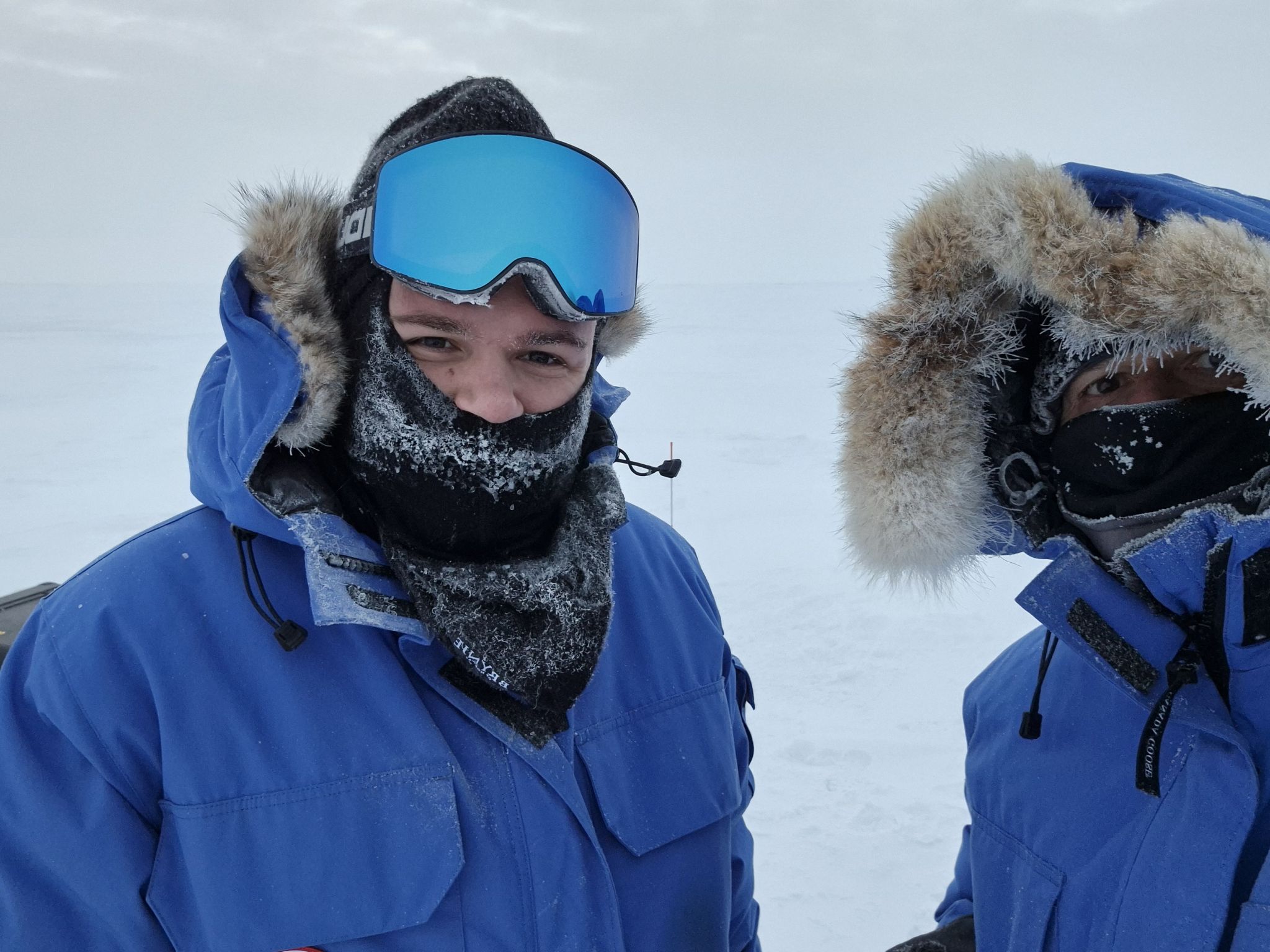
Watch: in the lab on Sky News
Sky News visit the Cold Room to learn more about the experiments in Cambridge.
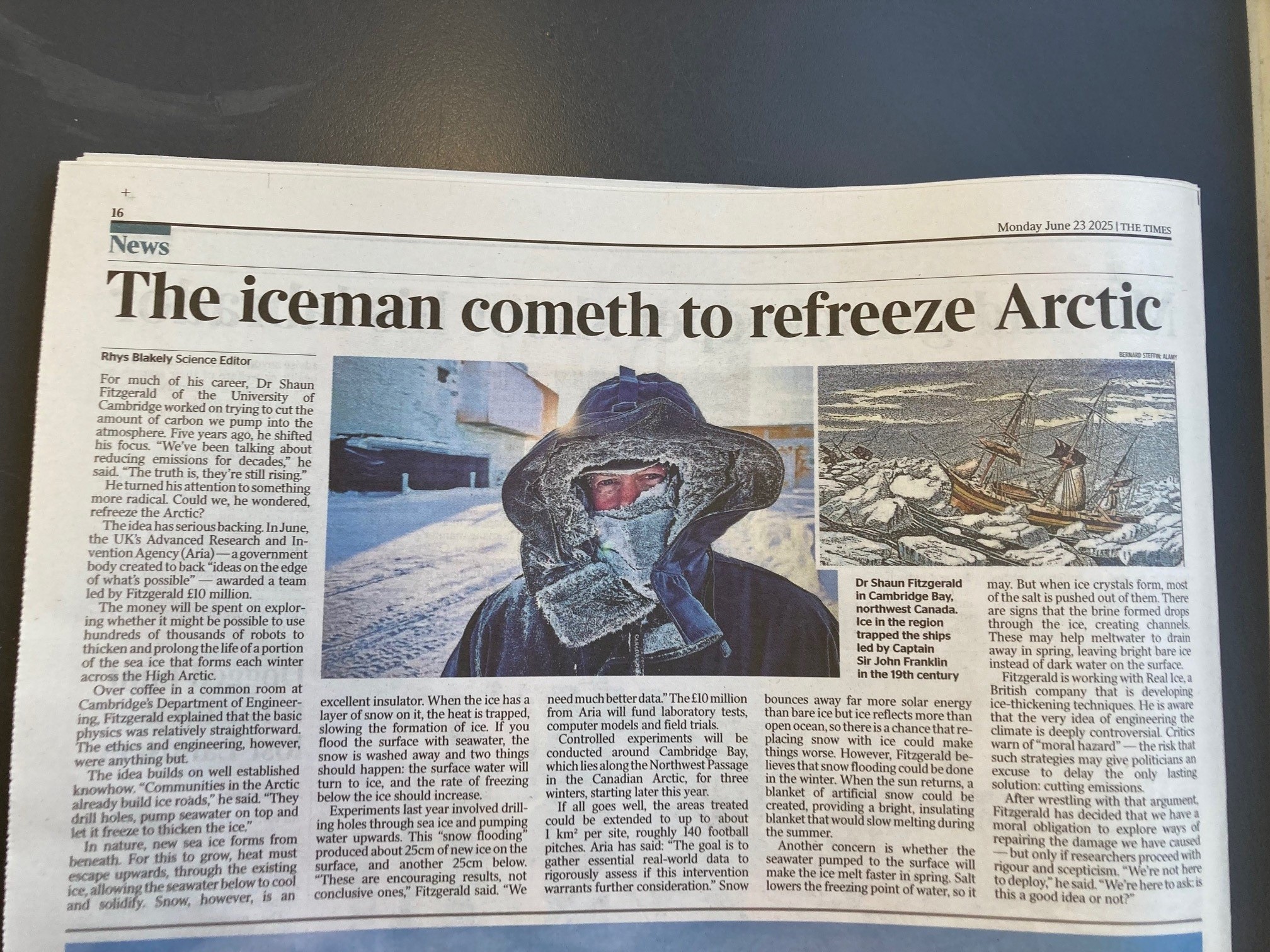
“The iceman cometh to refreeze the Arctic”
Ice thickening research featured in The Times.

On solid ice: the plan to refreeze the Arctic
Jacob Pantling in a feature on the project with Real Ice in Cambridge Bay.
Plan to refreeze Arctic ice shows promise in first tests
New Scientist shared promising results from the research.
Watch: Arctic warming is out of control. But can we fix it?
PBS Terra chat with Real Ice in this 10-minute documentary.
Watch: On the frontlines of an effort to save Arctic ice
The Narwhal spent time with the team and community in Nunavut.
Team


Collaborators


Updated 27/08/2025